
Standard Gain Horn Antennas
BBHA 9170 – Broadband Horn Antenna Linear polarized Broadband Horn Antenna (Brass with Plastic mounting body) for Receive and Transmit Applications. DatasheetRadiation Pattern Nominal Frequency Range: 15 – 26.5 GHz

BBHA 9170 – Broadband Horn Antenna Linear polarized Broadband Horn Antenna (Brass with Plastic mounting body) for Receive and Transmit Applications. DatasheetRadiation Pattern Nominal Frequency Range: 15 – 26.5 GHz
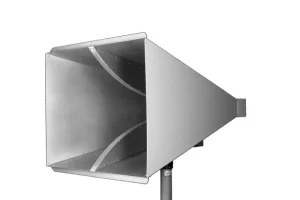
Overview Double Ridged Waveguide Horn Antennas The broadband horn antennas BBHA 9120 offer a very low SWR in their nominal frequency range and a very broad bandwidth. The gain increases

In addition to EMI measurement with LISNs (Line Impedance Stabilisation Networks, Artificial Mains Networks), Probes are used for Terminal or Line voltage measurement. LISNs are required to feed the Equipment under Test (EuT) with mains power, to reduce external line interference, to offer the EuT a standardized impedance and to route the extracted r.-f. voltage to the EMI receiver.
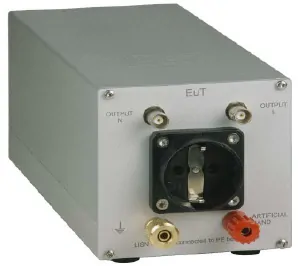

PG 01-2000 The pulse generator PG 01 – 2000 is suitable for insulation testing and testing the surge voltage strength of electrical and electronic electricity meters. When idle, the generator

IGUU 2918 Calibration-Pulse Generatoracc. CISPR 16for Band A, B, C, D(9 kHz-1000 MHz)To calibrate the pulseresponse of EMI receivers.Pulse repetition frequency main generator 0.1 – 200 Hz (aux. generator up

SY 9223-439 The SY 9223-439 transformer causes a voltage transformation Uin / Uout = 1 / 2 and is designed for operation with hand- held field coil – e.g. FESP
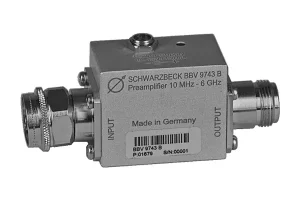
BBV 9743 B – Broadband Preamplifier Frequency range (nominel): 10 MHz – 6 GHz Noise figure: typ. <2.7 dB (1.0 GHz) Gain: typ. +28 dB Amplitude flatness: < ± 3
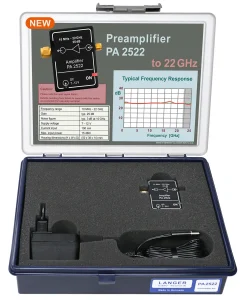
PA 2522 set Preamplifier 10 MHz up to 22 GHz The PA 2522 preamplifier was designed for the amplification of measuring signals, e.g. weak signals of near-field probes with high resolution.
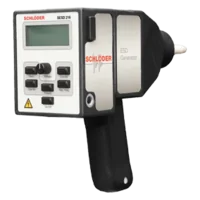
To ensure electronic and electrical devices withstand electrostatic discharges, ESD simulators are used to generate these discharges artificially and examine their effects on the devices. These tests, which evaluate the protective measures, are governed by standards such as IEC 61000-4-2 and ISO 10605.